Technical SEO Services
Even great content can struggle to perform when search engines cannot properly crawl, render, or index your website. Our technical SEO services identify these issues, prioritize the most important fixes, and build a strong technical foundation for sustainable search growth.
Technical SEO Works When Search Engines Can Trust Your Website
Reachress connects crawlability, Core Web Vitals, JavaScript rendering, structured data, redirects, canonical tags, migrations, and ongoing monitoring to the pages and templates that matter most. The goal is not simply to produce a lengthy audit, but to build a website where important pages remain accessible, measurable, and technically sound.
Technical SEO determines whether search engines can access the right pages, understand their content, and assign signals to the correct URLs. When this foundation is weak, other SEO efforts have to work harder to deliver results.
A website can have valuable content and strong authority, yet still face search visibility issues when important pages are difficult to reach, duplicate URLs split signals, JavaScript prevents content from being properly rendered, or technical changes affect performance. Crawlability, indexing, canonicalization, mobile usability, JavaScript, metadata, and internal links all work together as part of your site’s search infrastructure.
Even a high-value service page can underperform if it points to the wrong canonical URL, has rendering problems, becomes slower after a template update, or is accidentally removed from the sitemap. A strong technical foundation helps keep your SEO investments accessible, measurable, and stable as your website grows.
What’s Included in Our Technical SEO Services
At Reachress, our technical SEO process focuses on identifying issues, prioritizing the fixes that matter most, improving website performance, and monitoring your site after implementation. Our services cover the key technical areas needed to build a strong foundation for long-term search growth.

Technical SEO Services That Identify What’s Holding Your Website Back
Search visibility depends on how effectively search engines can crawl and understand your website. Our technical SEO audit identifies the issues that may be limiting your organic performance and turns them into clear, actionable priorities.
- Analyze crawl health, including server errors, broken links, orphan pages, and unnecessary URLs.
- Review site architecture, crawl depth, and internal linking to improve how authority flows across your website.
- Identify indexation issues, including important pages that are missed and pages that should not be indexed.
- Assess page speed and Core Web Vitals across key page templates to focus improvements where they matter most.
- Prioritize technical issues based on their potential impact on search visibility and organic traffic.
You get a clear technical baseline showing what needs attention, why it matters, and which fixes should be addressed first.
Core Web Vitals and Page Speed That Support Better Search Performance
Core Web Vitals measure important aspects of page experience, including loading speed, responsiveness, and visual stability. Our technical SEO process identifies the issues affecting these metrics and applies targeted improvements to strengthen website performance.
- Improve Largest Contentful Paint (LCP) by addressing slow servers, large images, and render-blocking resources.
- Improve Interaction to Next Paint (INP) by reducing JavaScript delays and improving page responsiveness.
- Reduce Cumulative Layout Shift (CLS) caused by late-loading images, fonts, and dynamic content.
- Benchmark website performance across key templates to identify areas with the greatest improvement potential.
- Monitor real-user performance data to validate improvements beyond laboratory testing.
The result is a faster, more stable website that provides a better experience for visitors and a stronger technical foundation for SEO.
Indexation and Crawl Budget That Keep Your Important Pages Visible
Search engines have limited resources for crawling websites, so it’s important to ensure those resources are focused on the pages that matter most. Our technical SEO process reviews crawl and indexation signals to help important pages get discovered, crawled, and indexed efficiently.
- Audit index coverage in Google Search Console to identify indexed, excluded, discovered, and error URLs.
- Analyze crawl activity to understand how search engine bots move through your website and where crawl issues occur.
- Review robots.txt and meta directives to prevent conflicts that block important pages or allow unnecessary crawling.
- Optimize faceted navigation and parameter URLs to reduce duplicate or low-value crawl paths.
- Maintain XML sitemaps with relevant, indexable, and canonical URLs to help search engines understand which pages should be prioritized.
The goal is to direct crawl activity toward your most valuable pages while reducing unnecessary URLs that can consume crawl resources.
Canonical and Redirect Management That Prevents SEO Signal Conflicts
When multiple URLs contain the same or similar content, search engines can struggle to determine which version should rank. Our canonical and redirect management helps consolidate SEO signals and ensure authority is directed toward the URLs you want to prioritize.
- Audit canonical tags across indexable pages to ensure ranking signals point to the preferred URLs.
- Identify and resolve redirect chains and loops that can waste crawl resources and weaken user experience.
- Standardize HTTP/HTTPS and www/non-www versions so alternate URLs do not compete with the primary version.
- Manage pagination, parameters, and filtered URLs to reduce duplicate and near-duplicate pages.
- Maintain redirect mappings for renamed, removed, or expired pages so valuable signals can be passed to relevant replacement URLs.
The result is a cleaner URL structure where your SEO authority is consolidated around the pages you want to rank.
Structured Data and Schema Markup That Helps Your Pages Stand Out in Search
Structured data helps search engines better understand your pages and can make eligible listings more informative in search results. Our technical SEO services identify the right schema types for each page and ensure the markup is accurate, relevant, and properly implemented.
- Audit existing schema for errors, warnings, and missed opportunities using Google’s validation tools.
- Select relevant schema types such as Product, FAQPage, LocalBusiness, BreadcrumbList, Article, and Organization based on page purpose.
- Implement JSON-LD correctly while avoiding conflicts with your CMS or website code.
- Monitor structured data and rich result eligibility through Google Search Console.
- Keep schema updated as your website content and structured data requirements evolve.
The result is accurate, well-maintained structured data that helps search engines understand your content and supports eligible enhanced search appearances.
Mobile Optimization and UX Improvements for Better Rankings and Conversions
Your mobile experience plays an important role in both search visibility and user experience. At Reachress, we optimize your website for mobile devices to ensure pages are fast, easy to navigate, and designed around how visitors actually browse and convert.
- Test mobile layouts across devices and screen sizes to improve usability, tap targets, and readability.
- Analyze Core Web Vitals across mobile and desktop to identify device-specific performance issues.
- Optimize navigation, forms, and calls to action for a smoother mobile experience.
- Prioritize important above-the-fold content so key information loads quickly on mobile connections.
- Identify UX friction through user behavior data and address areas where visitors struggle or abandon actions.
The result is a mobile-friendly experience that supports stronger engagement, search visibility, and conversions.
How Reachress Prioritizes Technical SEO Fixes
A technical SEO audit should focus on the issues that can have a meaningful impact on your website, rather than treating every warning as equally important. Prioritizing the right fixes helps your development team focus its time where it can make the greatest difference. Our technical SEO process turns crawl data, indexation signals, website performance, and development requirements into a practical order of priorities.
We evaluate issues based on their potential impact, affected pages, implementation effort, and risk. Problems affecting important templates, canonical patterns, or sitewide performance generally require more attention than isolated issues on low-value pages. Recommendations are organized with clear business context, showing which fixes affect important pages, which require development support, and which can be addressed later.
We also identify dependencies between SEO, development, and analytics. Some improvements involve indexation, internal linking, or structured data, while others require changes to templates, servers, or JavaScript. This makes it easier for your team to understand what needs to happen and who should handle it.
The goal is to avoid spending time on low-impact fixes while more important technical issues remain unresolved. We focus on practical improvements that can be implemented without waiting for a complete website rebuild. Your team receives a clear technical SEO roadmap showing what to fix first, what to include in upcoming development work, what to monitor, and what can wait.
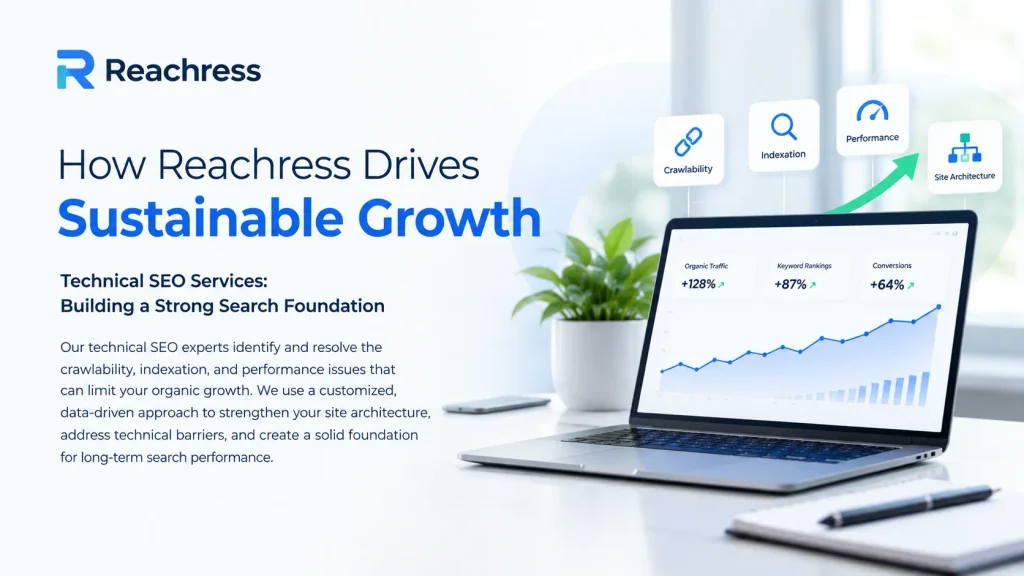
How Reachress Drives Sustainable Growth
Technical SEO Services: Building a Strong Search Foundation
Our technical SEO experts identify and resolve the crawlability, indexation, and performance issues that can limit your organic growth. We use a customized, data-driven approach to strengthen your site architecture, address technical barriers, and create a solid foundation for long-term search performance.
Get Your Free Technical SEO Audit
We’ll identify the technical issues affecting your search visibility and provide a clear, prioritized roadmap. Prefer to speak with us now? Call +92 325 7464015.